1. The Regulatory "Great Reset"—Transparency is the New Compliance
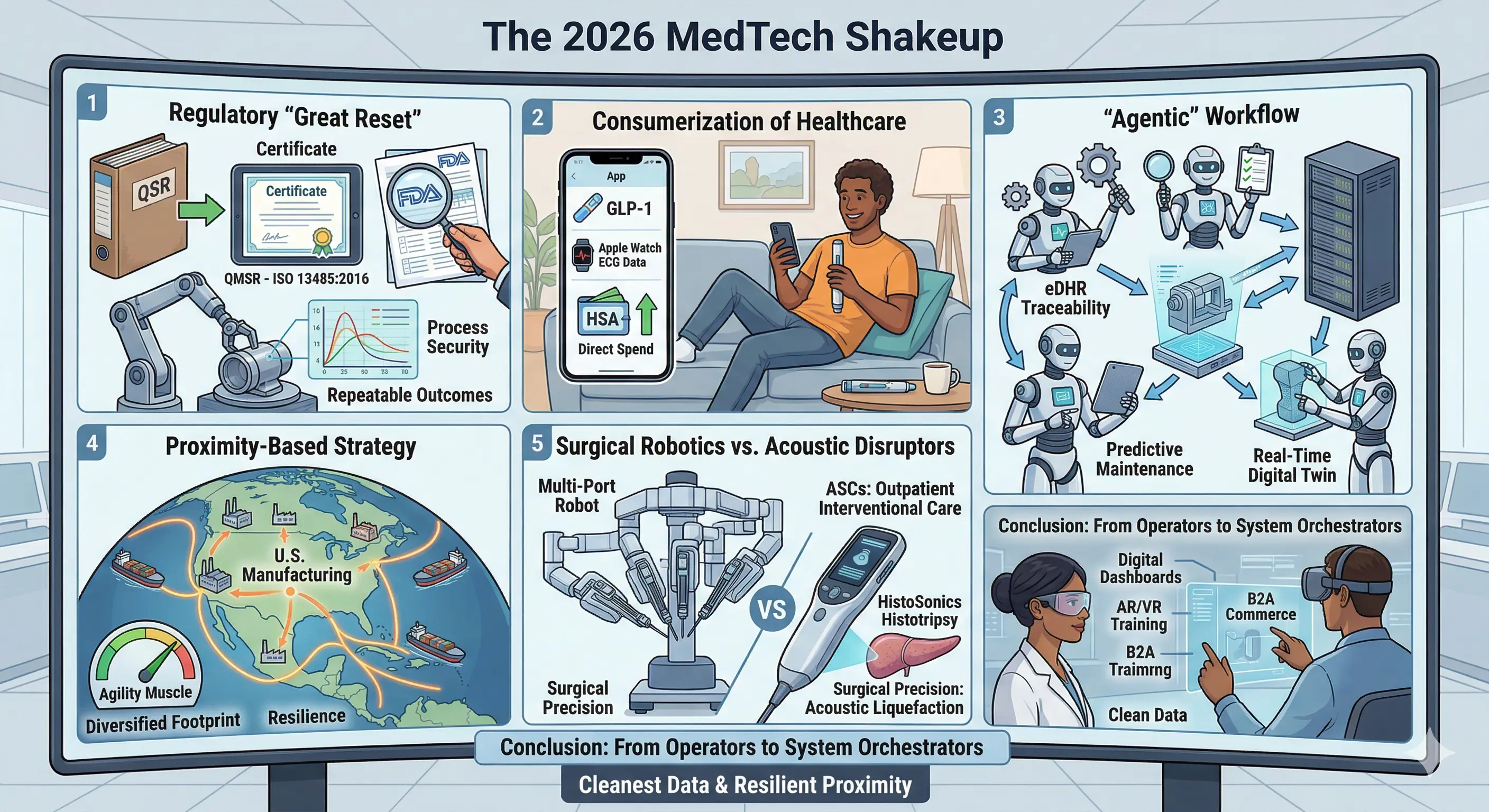
On February 2, 2026, the industry finally hit the "harmonization" milestone we’ve been chasing for a decade. The FDA officially retired the legacy Quality System Regulation (QSR) in favor of the Quality Management System Regulation (QMSR), aligning 21 CFR 820 with ISO 13485:2016.
For the C-suite, this saves hundreds of millions in redundant global audit overhead. But don't mistake this for a free pass. The "Great Reset" comes with a high-stakes sting: internal and supplier audit reports are now subject to FDA inspection. This shifts quality from a "check-the-box" administrative exercise to a raw, operationally visible business driver.
As Brian Falk, Director of Business Strategy at Scientific Cutting Tools, puts it:
"When the goal is reliable patient outcomes, 'good parts' are not enough. Manufacturers will need repeatable processes that can be proven, documented, and sustained, shift after shift."
On the shop floor, this means the technical depth of your thermal cycles matters more than ever. Whether you are processing Titanium or PH grades like 15-5 and 17-4, the FDA isn't just looking for a finished part—they are looking for the "process security" and objective evidence that your vacuum thermal cycles are stable and repeatable.
2. The "Blockbuster" Consumerization of Healthcare
We are witnessing an unprecedented "anti-pattern" where the traditional physician-gatekeeper model is being bypassed by the patient. Healthcare is no longer a clinical destination; it’s a living room activity.
The primary engine of this shift? The expansion of Health Savings Accounts (HSAs) as "entrepreneurial drivers." Consumers now have direct control over their healthcare dollars and are spending them on a new class of blockbuster products:
- GLP-1s: These metabolic medications have transitioned from clinical treatments to high-demand consumer "blockbusters."
- Wearable Diagnostics: The Apple Watch ECG and Evoke home-use concussion tools have moved medical-grade data into the user’s pocket.
- Home-Use Interventions: Consumer-accessible auto-injectors (EpiPens, Narcan) have turned the layperson into a first responder.
If you aren't designing for the "patient-buyer," you are missing the fastest-growing segment of the market.
3. Beyond the AI Hype—The Era of the "Agentic" Workflow
The honeymoon phase of AI is over, and the morning after is a bit sobering. While nearly half of MedTech leaders see digital transformation as high-impact, only 9% report significant returns on AI.
The 2026 solution to this ROI gap is the shift from "Generative AI" to "Agentic AI." Instead of isolated chatbots, we are seeing domain-specific agents that communicate and coordinate across entire tech ecosystems. These agents turn "tribal knowledge" into automated, intelligent networks.
Successful organizations are now using these agents to automate:
- Electronic Device History Records (eDHR): Achieving perfect, real-time traceability without manual human error.
- Predictive Machine Maintenance: Using real-time performance data to turn reactive maintenance into a predictable revenue stream.
- Real-Time Process Correction: Utilizing "Digital Twins" to identify quality bottlenecks virtually before a single ounce of material is consumed.
- 4. Geopolitics Forces a "Proximity-Based" Strategy
The strategic map has been redrawn by necessity. A staggering 39% of executives now view geopolitical tension as a top operational risk—a massive 20-point jump in just twelve months.
The era of "efficiency at any cost" is dead, replaced by "resilience through proximity." Manufacturers are aggressively reshoring to the U.S. and nearshoring to Mexico to protect compliance timelines from long-tail supply chain volatility. By diversifying your footprint, you aren't just saving on freight; you are building an "agility muscle" that allows you to react to global shocks without being tethered to a single vulnerable logistics route.
5. Surgical Robotics vs. The "Acoustic" Disruptors
The operating room of 2026 is seeing a clash between mechanical giants and "robotics-adjacent" energy. While multi-port systems like Medtronic’s Hugo and J&J’s OTTAVA are expanding their footprints, they are being challenged by "acoustic disruptors" that bypass the scalpel entirely.
Technologies like HistoSonics’ incisionless histotripsy and Petal Surgical’s acoustic liquefaction represent a shift toward energy-based, image-guided therapies. This isn't just about "cool tech"—it’s about the Ambulatory Service Center (ASC). Traditional robots often carry a capital burden too heavy for ASCs; these energy-based disruptors provide robotic-level precision with a form factor and price point that finally makes high-end interventional care viable in the outpatient setting.
.svg)

.webp)
.webp)